
The Healthcare Staffing Math That Doesn't Work Anymore
A clinical staffing manager posts a req for an open position on a Monday. By the following Monday, she had reposted it twice, raised the pay range once, and started asking her own staff to pick up extra shifts to cover the gap. This is not a story about one hospital having a bad month. It is the operating reality in healthcare staffing right now, and it has stopped responding to the playbook that used to work: post the job, wait, fill it eventually.
The math behind that playbook assumed a steady supply of candidates moving through a predictable pipeline. That assumption no longer holds, and understanding why matters more than reacting to the symptom.
Why the Supply Side Broke
Healthcare and social assistance is projected to be the fastest-growing sector in the U.S. economy through 2034, adding roughly 2 million jobs and outpacing every other industry, according to the Bureau of Labor Statistics. That is demand-side growth. The supply side has not kept pace, and it is not close.
Three structural forces are driving the gap. The population needing care is aging faster than the workforce providing it is growing, which means demand keeps climbing on a fixed or slow-growing base of clinicians. Training pipelines for many clinical roles take years to produce a single qualified candidate, so supply cannot respond quickly even when interest in the field increases. And geography compounds both problems: rural and underserved markets, along with niche specialties, were already thin on candidates before demand accelerated, and they have not caught up.
This is a structural mismatch, not a temporary disruption. A staffing strategy built for temporary disruptions will keep underperforming against a structural one.
The Part That Doesn't Show Up in the Job Posting
Burnout gets discussed as a separate issue from the talent shortage, but the two feed each other directly. When a unit is short-staffed, the clinical professionals who are there absorb the difference. That shows up as longer shifts, more patients per clinician, and less recovery time between hard cases.
The encouraging news is that the trend is moving in the right direction. AMA data shows physician burnout has declined for three consecutive years, from 48.2% in 2023 to 43.2% in 2024 to 41.9% in 2025. But that overall improvement masks real unevenness. Specialties under the most acute staffing pressure, including emergency medicine and obstetrics and gynecology, continue to report burnout rates well above the average, approaching or exceeding 49%. In other words, the places where staffing gaps hit hardest are exactly where burnout is most stubborn.
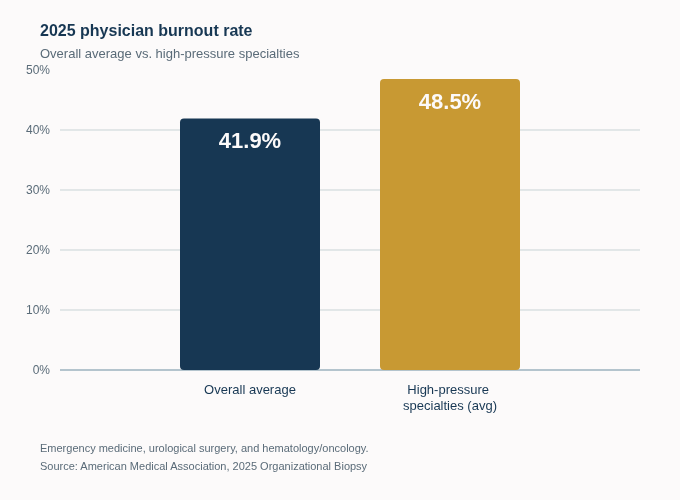
Source: American Medical Association, 2025 Organizational Biopsy
That unevenness is the more useful signal than the topline number. An organization can be improving on average while its highest-pressure units are still losing people. Staffing strategy needs to account for where the strain actually concentrates, not just the system-wide trend.
Why Compliance Makes This Harder to Solve Quickly
Healthcare staffing operates inside a regulatory structure that adds real friction to closing a gap fast. Licensure requirements vary by state and role. Credentialing has to be verified before someone sets foot on a unit, not after. Documentation has to hold up to audit. None of this is optional, and none of it can be shortcut without creating risk that is far more expensive than the staffing gap itself.
This is the part of the equation that a generic staffing approach tends to underweight. Speed without verification is not a solution in healthcare. It is a liability waiting to surface during the next survey or the next incident review. Any approach to closing staffing gaps quickly has to be able to do both at once: move fast and document everything correctly the first time.
What Actually Changes the Equation
Flexible staffing models, including contract, per diem, and travel placements, address the structural mismatch in a way that purely permanent hiring cannot. A permanent req has to wait for the right long-term fit. A flexible placement only has to be the right fit for the duration of the need, which opens up a meaningfully larger candidate pool for the same vacancy.
The deeper benefit is what this does for the staff who are already there. When a unit can bring in qualified contract or per diem coverage during a volume spike or a leave of absence, the existing team is not the only pressure valve. That has a direct line to the burnout and retention numbers above. Coverage that arrives before a unit hits a breaking point protects the people who would otherwise absorb that gap, and protecting them is what keeps them from becoming the next vacancy.
None of this works without rigor on the vetting side. A flexible model that trades quality for speed just moves the risk from "vacant role" to "underqualified placement," which is its own patient-safety and compliance problem. The organizations getting real value from flexible staffing are the ones treating speed and vetting as a single requirement, not a tradeoff.
Where This Leaves Healthcare Leaders
The shortage is not closing on its own, and the demand curve is not flattening. Leaders who treat staffing as a single department's reactive function will keep losing ground. Leaders who build a flexible, well-vetted staffing capacity into their actual operating model, the way they already plan for census fluctuations or seasonal volume, are the ones positioned to keep quality of care stable while the supply-demand gap plays out over the next decade.
See how a flexible staffing partnership actually works in practice. Schedule a conversation with our team to talk through your specific staffing gaps and what a tailored approach could look like for your organization.